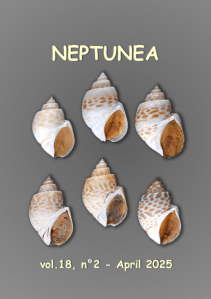
 The variability of Babylonia spirata (Linnaeus, 1758) (Mollusca: Gastropoda: Babyloniidae), and perspectives on the taxonomic status of Babylonia semipicta (G.B. Sowerby II, 1866), pp.1-22, pls I-XVI, by Frank Nolf & Steve Hubrecht
Keywords: Mollusca, Gastropoda, BABYLONIIDAE, Babylonia spirata, Babylonia semipicta, Babylonia rubroaurantiaca, junior synonyms.
Abstract: An examination of hundreds of specimens of Babylonia led to a comprehensive survey of the variability of Babylonia spirata (Linnaeus, 1758), presented through a series of illustrations. In addition, Babylonia rubroaurantiaca is proposed as a junior synonym of B. spirata, and the taxonomic status of Babylonia semipicta (G.B. Sowerby II, 1866) is again re-evaluated. Recent findings by Yen et al. (2024), employing multi-locus phylogeny and delimitation methods, suggested evidence for its recognition as a distinct species. However, the present study challenges this conclusion by demonstrating the variability of Babylonia semipicta in a continuum of intermediate forms. Similar patterns are observed in Babylonia borneensis (G.B. Sowerby II, 1864), where comparable morphologies can also be found. Consequently , Babylonia semipicta is reaffirmed as a junior synonym of Babylonia spirata.
About the presence of Naticarius canrena (Linnaeus, 1758) (Mollusca: Gastropoda: Naticidae) in West African waters, pp. 23-36, pls I-VIII, by Frank Nolf
Keywords: Mollusca, Gastropoda, NATICIDAE, Naticarius canrena, Atlantic Ocean.
Abstract: Two specimens of Naticarius canrena (L., 1758) have been collected from Senegal. To the best of our knowledge, this represents the first documented occurence of this Western Atlantic species in West African waters. The discovery raises the question of whether these specimens represent an isolated, accidental presence or if additional specimens exist within shell collections but have been misidentified as Natica turtoni E.A. Smith, 1890, Natica bouvieri Jousseaume, 1883, or Natica canariensis Odhner, 1931. The present study provides a comparative analysis of these four species.
 Neptunea